
✅ Quiz M4.01#
Question
Imagine you work for a music streaming platform that hosts a vast library of songs, playlists, and podcasts. You have access to detailed listening data from millions of users. For each user, you know their most-listened genres, the devices they use, their average session length, and how often they explore new content.
You want to segment users based on their listening patterns to improve personalized recommendations, without relying on rigid, predefined labels like “pop fan” or “casual listener” which may fail to capture the complexity of their behavior.
What kind of problem are you dealing with?
a) a supervised task
b) an unsupervised task
c) a classification task
d) a clustering task
Select all answers that apply
Question
The plots below show the cluster labels as found by k-means with 3 clusters, only differing in the scaling step. Based on this, which conclusions can be obtained?
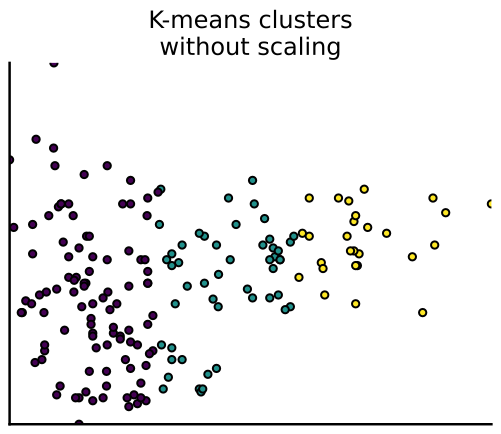
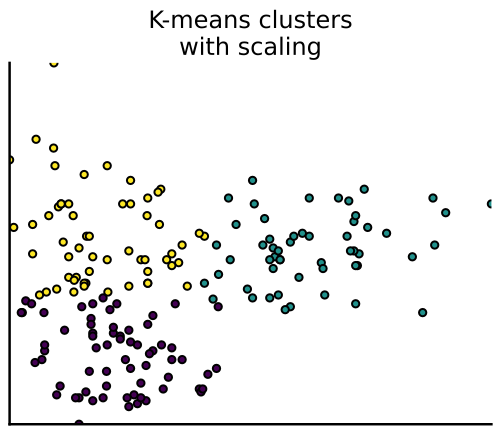
a) without scaling, cluster assignment is dominated by the feature in the vertical axis
b) without scaling, cluster assignment is dominated by the feature in the horizontal axis
c) without scaling, both features contribute equally to cluster assignment
Select a single answer
Question
Which of the following statements correctly describe factors that affect the stability of k-means clustering across different resampling iterations of the data?
a) K-means can produce different results on resampled datasets due to sensitivity to initialization.
b) If data is unevenly distributed, the stability improves when increasing the parameter
n_initin the “k-means++” initialization.c) Stability under resampling is guaranteed after feature scaling.
d) Increasing the number of clusters always reduces the variability of results across resamples.
Select all answers that apply
Question
Which of the following statements correctly describe how WCSS (within-cluster sum of squares, or inertia) behaves in k-means clustering?
a) For a fixed number of clusters, WCSS is lower when clusters are compact.
b) For a fixed number of clusters, WCSS is lower for wider clusters.
c) For a fixed number of clusters, lower WCSS implies lower computational cost during training.
d) Assuming
n_initis large enough to ensure convergence, WCSS always decreases as the number of clusters increases.
Select all answers that apply
Question
Which of the following statements correctly describe differences between supervised and unsupervised clustering metrics?
a) Supervised clustering metrics such as ARI and AMI require access to ground truth labels to evaluate clustering performance.
b) WCSS and the silhouette score evaluate internal cluster structure without needing reference labels.
c) V-measure is zero when labels are assigned completely at random.
d) Supervised clustering metrics are not useful if the number of clusters does not match the number of predefined classes.
Select all answers that apply